Send the exact assignment or rubric from your classroom and a custom sample written to it lands in 24 to 48 hours, the first one free. NR 580 is Chamberlain’s Adult-Gerontology Primary Care Capstone and Intensive course. It centers on carrying one patient through assessment, reasoning, plan and follow-up so the parts hold together under questioning. Searches like "nr 580 week 4 assignment example", "NR580 sample paper", and "NR 580 week samples" land on this page.
What NR 580 is really about
By NR 580 nothing in the sequence is new, and that is the difficulty. Earlier courses marked a differential, a regimen or a conversation on its own, and each could be strong while the others were absent. Here one case has to hold from the first history to the return interval, and the usual failure is not ignorance but inconsistency: a plan that does not follow from the assessment, a medicine unchanged after a diagnosis moved, a preference recorded in week two and contradicted in week seven. Whoever reads a capstone is checking the joins. The intensive adds pressure to that, since defending a decision out loud removes any chance to repair it quietly afterwards.
The second thing this course wants is an honest account of your own gaps. A self-assessment finding nothing missing tells a reader you have not looked, while one naming two populations or procedures you remain weak in, and what you did about them, reads as readiness. Certification style questions work the same way, rewarding the reasoning that eliminates rather than the answer that simply appears. Practicum hours, the clinical logbook and any preceptor evaluation are your own record of your own placement, and they are never written by anybody else. What a sample can show is how a finished case gets assembled, never what happened in your clinic.
What NR 580’s assessments ask for
Weekly work in many sections alternates between building and defending. Assignments commonly ask for a full write-up on a complex adult or older adult patient, with the history, the examination, the reasoning, the therapeutic plan and the follow-up in one document a reader can audit for contradictions. Others ask for a presentation of that same case, where the questions land on the decision you were least sure about. A self-assessment usually asks what you can and cannot yet do without supervision, and expects specifics rather than sentiment. Discussions early in the week circulate cases for challenge, and points come from testing a classmate's reasoning instead of praising the format of their document.
Where students lose points in NR 580
The failure that costs most here is the case that does not join up: an assessment naming three problems and a plan addressing one, or a follow-up interval that makes no sense given the risk described two pages earlier. Second is narration standing in for evidence, where a portfolio describes growth in general terms and never shows the work that would demonstrate it. Third is the self-assessment with no gaps, which reads as either incurious or unwilling. Presenting a case without the reasoning behind it, defending a decision by quoting the assignment instructions rather than the patient, padding a document so it looks complete, and letting stated goals disappear between sections all lose points.
The NR 580 drawers
NR 580 Week 1 discussion post example
Week 1 in many sections asks which part of your practice still needs a supervisor. On request, free, 24-48h.
NR 580 Week 2 case presentation example
Week 2 generally presents a complicated patient for questioning rather than for praise. On request, free, 24-48h.
NR 580 Week 3 comprehensive case write-up example
Week 3 commonly runs one patient from first history through to return interval. On request, free, 24-48h.
NR 580 Week 4 clinical decision brief example
Week 4 typically defends the single decision everything else in the plan depends on. On request, free, 24-48h.
NR 580 Week 5 gap analysis example
Week 5 often asks what you still cannot do without somebody watching. On request, free, 24-48h.
NR 580 Week 6 self-assessment write-up example
Week 6 usually converts those admitted gaps into a plan with dates. On request, free, 24-48h.
NR 580 Week 7 complex case synthesis example
Week 7 frequently joins assessment, therapy and follow-up on one demanding patient. On request, free, 24-48h.
NR 580 Week 8 readiness reflection example
Week 8 tends to ask what changed between your first case and this one. On request, free, 24-48h.
Your classroom shows something else?
Chamberlain University revises courses; week counts and deliverables shift between terms. Send what your classroom shows and the desk matches it exactly.
Using a NR 580 sample the right way
Read a finished sample backwards. Start at the follow-up, then check whether the plan above it earns that interval, whether the reasoning supports the plan, and whether the history collected the evidence that reasoning depends on. Faults in a capstone show up as gaps between sections, so that is where to look and what to imitate. Then build your own case from your own placement, because the patient, the decisions and the record of your hours are yours. What a sample offers is a picture of a document that holds together under pressure.
How these samples are written
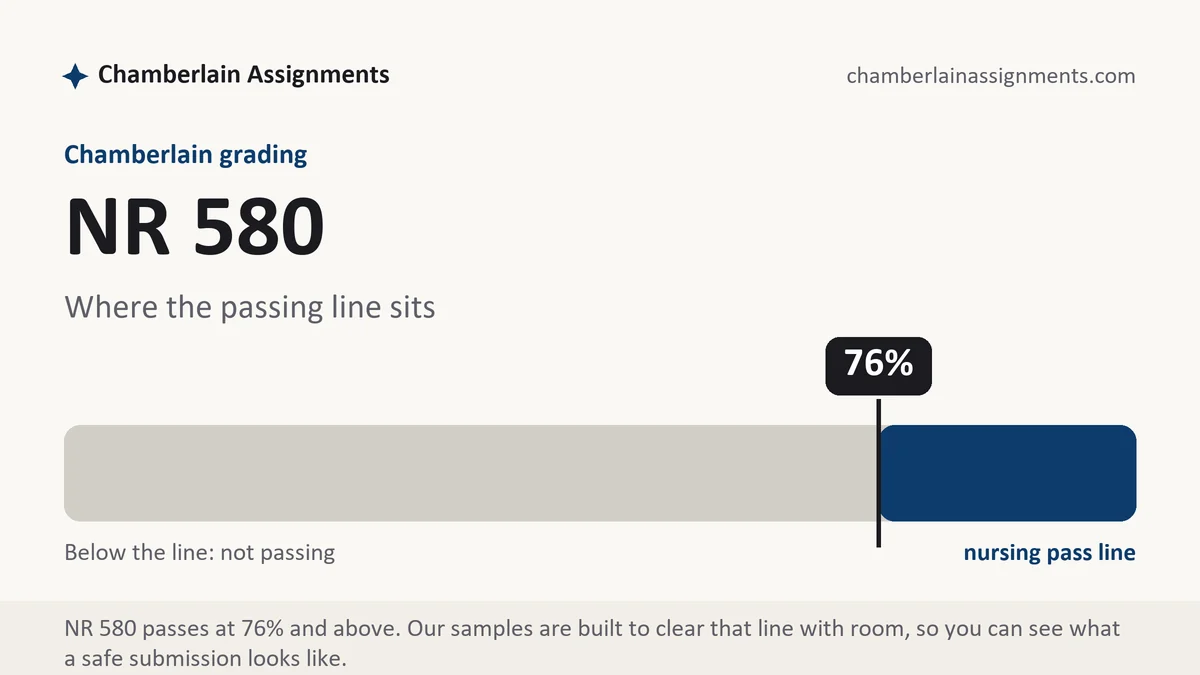
The discipline behind every paper here: the rubric is the outline, each row gets its section, one-shot discussions get the one-shot treatment, and the 76 percent floor is treated as the cliff it is. Send your week's instructions with a request and the sample matches them, revisions included.
NR 580 questions, answered
How do I choose which patient to build the capstone around?
Pick one with enough going on that your reasoning becomes visible. A patient with a single obvious problem gives you nothing to defend, while one carrying several conditions, a long regimen and a preference that complicates the guideline lets every part of the sequence appear. Complexity is the point, provided you can document the case accurately and without identifying anybody.
What does the intensive expect that written work does not?
Speed and consistency. Answering out loud removes the editing pass, so your reasoning has to be settled before you arrive: why this candidate over that one, what you would order first, what would change your mind. Rehearse the argument in a few sentences, and prepare the decisions you feel least confident about rather than the ones you already enjoy explaining.
Can a sample be used for my practicum documentation?
No, and the two are different objects. A sample shows how a finished case write-up is assembled and what a marker reads it for. Your hours, your logged encounters and anything a preceptor signs describe a placement only you attended, so those stay entirely in your hands and are never drafted for you.