Send the exact assignment or rubric from your classroom and a custom sample written to it lands in 24 to 48 hours, the first one free. NR 670 is Chamberlain’s Advanced Nursing Leadership Concluding Graduate Experience course. It centers on a concluding experience that appraises you as a leader rather than reporting on the project you happened to run. Some program versions carry this course as NR 670A; the same drawers apply. Searches like "nr 670 week 4 assignment example", "NR670 sample paper", and "NR 670 week samples" land on this page.
What NR 670 is really about
NR 670 closes a leadership track rather than a project sequence, and the difference shows in what it asks you to produce. The work of the session is an account of your own practice as a leader, built from things you actually did, with evidence attached. That is not a reflection in the loose sense. Each claim about your capability has to point at an artifact: the analysis you wrote, the meeting you ran, the decision you made when two departments wanted opposite things. Faculty are appraising the leader, and the project you happened to work on is evidence rather than subject. The distinction sounds small on a syllabus and changes every paragraph you write.
Most people find the register unfamiliar. Writing about yourself with authority, without either advertising or apologizing, is a skill the earlier courses never quite demanded. The strongest versions are specific and unflattering in places, because a leader who cannot name a decision that went badly reads as someone who has not examined one. There is usually a competency structure behind the assignment, and the practical effect is that each element needs a real example, not a paragraph of intent. Anything your organization signs, along with hour records and site documentation, is yours to keep and complete; the argument you build on top of it is ordinary graduate writing.
What NR 670’s assessments ask for
The session usually moves from evidence gathering to a defended account. Early weeks ask you to inventory what you have actually done and map it against the capability set the program uses, which is harder than it sounds because most people undersell routine work and oversell one dramatic episode. Middle weeks turn individual episodes into short analytic pieces, each showing a situation, a decision, a consequence and a revision. Later weeks assemble those into a single account, often with a presentation or a summary written for executives. Rubric rows here tend to name the capability, so the classroom template is worth reading as an outline. Discussions run through the session and reward replies that press a classmate on whether their evidence supports the capability they claim from it.
Where students lose points in NR 670
Two failures dominate. The first is the resume in prose: a list of roles held and courses completed, with capability asserted and never demonstrated, which gives a grader nothing to assess. The second is the reflection with no edges, where every experience was valuable and every setback became a learning opportunity, and the writing floats a foot above anything that happened. Faculty at this stage also mark down accounts where the leadership was always somebody else's, so responsibility for a poor outcome never lands anywhere. Missing artifacts, capability claims supported by a course grade rather than an action, and a closing development plan with no next step attached are the three comments that recur.
The NR 670 drawers
NR 670 Week 1 discussion post example
Week 1 often asks what kind of leader your record so far actually shows. On request, free, 24-48h.
NR 670 Week 2 competency self-inventory example
Week 2 typically maps work already done against the capability set your program uses. On request, free, 24-48h.
NR 670 Week 3 leadership episode analysis example
Week 3 commonly takes one decision apart, including what you would now do differently. On request, free, 24-48h.
NR 670 Week 4 evidence portfolio piece example
Week 4 usually attaches an artifact to each capability you intend to claim. On request, free, 24-48h.
NR 670 Week 5 conflict decision write-up example
Week 5 frequently examines a moment when two departments wanted opposite outcomes. On request, free, 24-48h.
NR 670 Week 6 organizational impact analysis example
Week 6 often asks what changed at your site because you held the role. On request, free, 24-48h.
NR 670 Week 7 development plan example
Week 7 in many sections turns identified gaps into commitments with dates attached. On request, free, 24-48h.
NR 670 Week 8 leadership portfolio presentation example
Week 8 usually presents the whole account to an audience that will ask questions. On request, free, 24-48h.
Your classroom shows something else?
Chamberlain University revises courses; week counts and deliverables shift between terms. Send what your classroom shows and the desk matches it exactly.
Using a NR 670 sample the right way
Treat a sample as an appraisal rather than a report, and read it for how a claim gets attached to proof. Find a place where the writer says they can do something and follow the sentence that earns it; if the evidence is a description of the work rather than the work itself, that is the gap your own draft will have too. Notice how failure is handled without collapse. Then build yours from your own record, because the artifacts are the part nobody else has, and they decide whether the account is convincing. Read the development section too, since a plan with dates in it reads very differently from one made of intentions.
How these samples are written
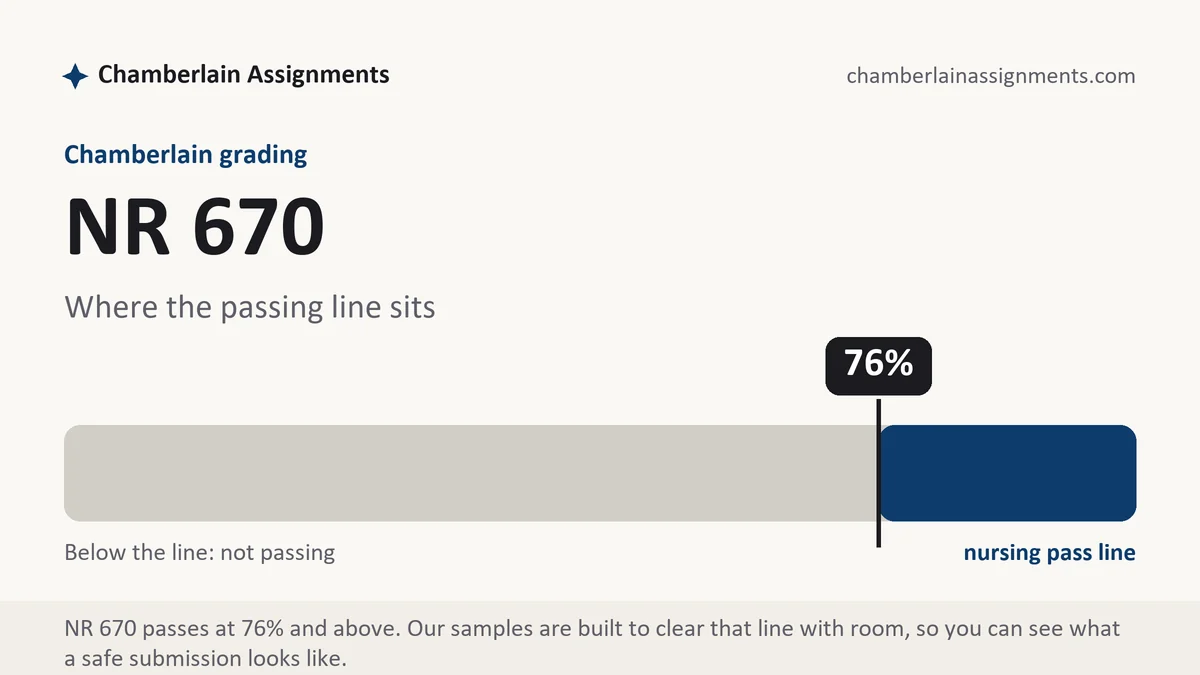
The discipline behind every paper here: the rubric is the outline, each row gets its section, one-shot discussions get the one-shot treatment, and the 76 percent floor is treated as the cliff it is. Send your week's instructions with a request and the sample matches them, revisions included.
NR 670 questions, answered
How is this different from a project write-up?
The subject changes. A project write-up argues about a change and its results; this argues about you, using the change as evidence. The same events appear, but the organizing question becomes what your handling of them shows about your capability as a leader, and the structure follows the capabilities rather than the project timeline.
Should I include something that went badly?
Yes, and choose one you understood afterward. A decision that failed, followed by an honest account of what you missed and what you did differently next time, demonstrates the judgment the course is looking for. Uninterrupted success reads as either luck or omission, and graders have read enough of both to tell the difference quickly.
Can a sample be written around my own leadership record?
The structure can, and that is usually what people need. Send the assignment instructions, the rubric and any competency template your classroom provides, and the first custom sample is free in 24-48h, built around a comparable role so you can see how evidence is arranged. Your own artifacts stay yours to supply.