Send the exact assignment or rubric from your classroom and a custom sample written to it lands in 24 to 48 hours, the first one free. NR 719 is Chamberlain’s Topics in Advanced Practice Leadership II course. It centers on the executive side of practice change, sustaining results, planning dissemination, and arguing leadership decisions in systems and budget terms. Searches like "NR 719 week 4 assignment example", "NR719 sample paper", and "NR 719 week samples" land on this page.
What NR 719 is really about
NR 719 continues directly from its predecessor, but the altitude changes. Where the first leadership course worked at the level of teams and resistance, this one typically thinks in systems: how a successful practice change survives staff turnover, how results get reported upward, what a realistic budget case for continuation looks like, and how findings travel beyond one unit through dissemination. The course usually runs while the DNP project is generating real results, so assignments can draw on live material. Discussions early in the week tend toward strategy questions, and the Sunday assignments push you to write for executive readers, shorter, harder-edged documents than the papers earlier in the program.
By this point the program assumes fluency, so feedback concentrates on judgment: whether your sustainability plan names an owner and a funding line, whether your dissemination choice fits the audience that needs the finding, whether your leadership positions still trace back to the framework you committed to at the start of the doctorate. Samples on the NR 719 shelf are selected for exactly that maturity. They argue continuation in budget terms, choose venues deliberately, and keep the project's theoretical spine visible in executive prose without lecturing about it. One line stays firm: your practicum documentation belongs to you and is never part of what we draft. The thinking around it is fair game, and that is what these models teach.
What NR 719’s assessments ask for
The rhythm holds steady, discussions opening the week, assignments closing it Sunday, but the deliverables change shape. In many sections you draft a sustainability plan for the project's change, build a dissemination strategy with a chosen venue and audience, and argue at least one strategic leadership decision in a paper or executive summary written for decision-makers rather than professors. Rubrics at this stage reward economy and consequence: fewer definitions, more commitments, numbers where numbers persuade. Peer response is often graded seriously because critique is itself an executive skill. The course also quietly checks alignment, expecting the leadership stance you argue here to be consistent with the project you have been reporting all along.
Where students lose points in NR 719
Late-program leadership papers fail by reverting. Under deadline pressure, students fall back on reviewing what the literature says about sustainability or dissemination, and the paper reads like an annotated reading list at the exact moment faculty want an executive arguing for a decision. The grade penalty is heavier in NR 719 than earlier, because the noncommittal move now looks like a doctoral habit rather than a rookie one. Two other patterns recur: the framework adopted back in the underpinnings course disappears from the final leadership arguments, leaving a project that no longer matches its stated theory, and reference lists carried forward since early terms quietly age past the currency window. Every sample on this shelf was screened against all three before it earned a place.
The NR 719 drawers
NR 719 Week 1 discussion post example
Sections often begin by taking stock of the project's results and remaining leadership work. On request, free, 24-48h.
NR 719 Week 2 leadership position paper example
Systems-level thinking, spread, scale, and institutional context, typically frames the early discussions. On request, free, 24-48h.
NR 719 Week 3 sustainability plan example
A sustainability plan naming owners, measures, and funding is a frequent assignment. On request, free, 24-48h.
NR 719 Week 4 budget justification write-up example
Budget and resource arguments for continuing the change often anchor this stretch. On request, free, 24-48h.
NR 719 Week 5 outcomes evaluation write-up example
Many sections turn to dissemination strategy, matching findings to venues and audiences. On request, free, 24-48h.
NR 719 Week 6 dissemination plan example
Executive communication work, often a summary for decision-makers, commonly appears here. On request, free, 24-48h.
NR 719 Week 7 executive summary example
A strategic leadership paper defending a systems-level decision typically lands late. On request, free, 24-48h.
NR 719 Week 8 project dissemination presentation example
Week 8 usually closes the leadership pair with reflection tied to the project's trajectory. On request, free, 24-48h.
Your classroom shows something else?
Chamberlain revises courses; week counts and deliverables shift between sessions. Send what your classroom shows and the desk matches it exactly.
Using a NR 719 sample the right way
Choose samples by document type, because an executive summary and a scholarly paper obey different rules even when the content overlaps. Study how the summaries front-load the decision and how the sustainability plans attach every commitment to an owner and a cost. If a sample argues a position you disagree with, better still; drafting your counterargument is the fastest preparation for graded peer exchange. When your section's deliverable has its own template, send the instructions and rubric and we will write the first custom sample free, in 24-48h, matched to it. Finish by checking your draft against your own earlier courses, since consistency is now part of what is graded.
How these samples are written
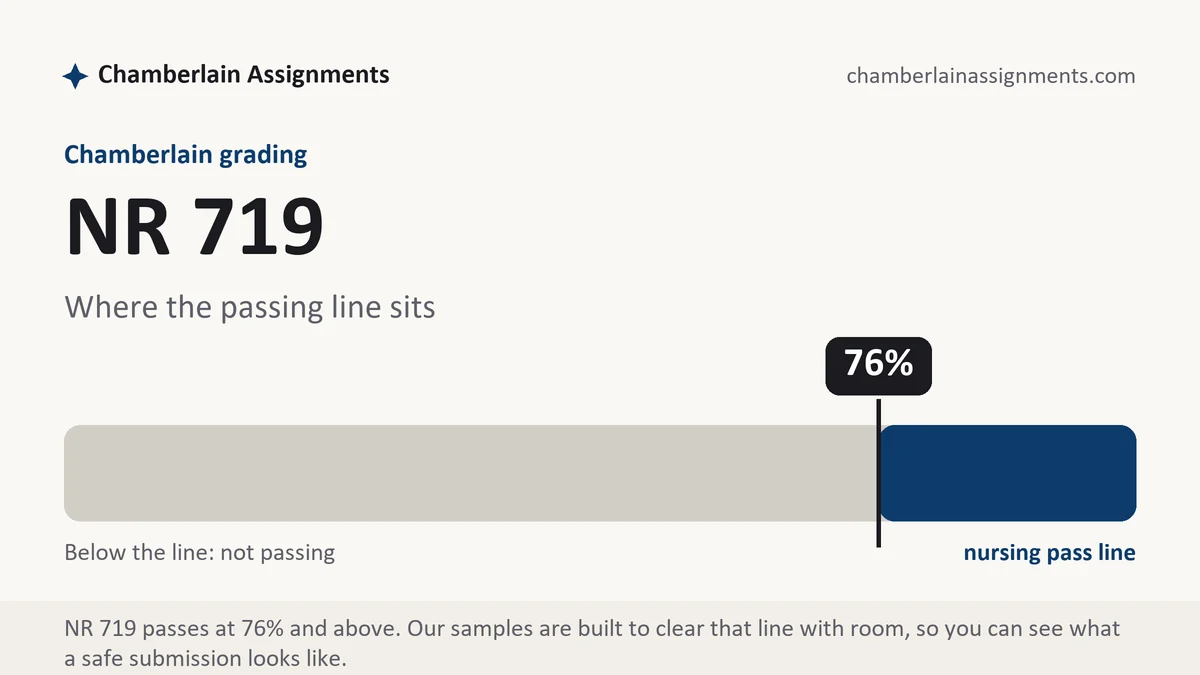
The discipline behind every paper here: the rubric is the outline, each row gets its section, one-shot discussions get the one-shot treatment, and the 76 percent floor is treated as the cliff it is. Send your week's instructions with a request and the sample matches them, revisions included.
NR 719 questions, answered
What makes a sustainability plan read as doctoral instead of aspirational?
Ownership and money. A doctoral plan names who monitors the change after you leave, what data they watch, and which budget keeps it alive, then defends why that arrangement survives turnover. Aspirational plans say leadership support will continue. Our NR 719 samples model the first kind, and the difference is visible within a page. Send your rubric if you want the free first sample built on your project's shape, 24-48h.
My project no longer matches the framework I chose at the start. Does that matter in this course?
It matters more here than anywhere, because NR 719 is where faculty check whether the doctorate holds together. A framework that vanished from your leadership arguments reads as decoration in hindsight, the exact failure doctoral review is trained to catch. The repair is honest re-mapping: show which concepts still operate in the sustained change and say plainly what shifted. Our samples demonstrate that move without pretending the drift never happened.
Which venue should my dissemination plan target, and do samples help me choose?
Samples show the reasoning, not a universal answer: match the finding to the audience that can act on it, then meet that venue's format and evidence expectations, including source currency, since submitting work built on citations past the window invites rejection twice, in the classroom and at the venue. A free first custom sample written to your assignment instructions and rubric can walk that logic through your own project in 24-48h.