Send the exact assignment or rubric from your classroom and a custom sample written to it lands in 24 to 48 hours, the first one free. NR 720 is Chamberlain’s Topics in Healthcare Systems Leadership I course. It centers on diagnosing the problems that live between departments, where the work fails at a handoff nobody owns. Searches like "nr 720 week 4 assignment example", "NR720 sample paper", and "NR 720 week samples" land on this page.
What NR 720 is really about
NR 720 is a topics course, and the topic running under all of them is the failure that has no owner. Patients wait because radiology and the floor schedule against different priorities. Supplies run short because ordering was optimized for a budget line nobody attached to clinical demand. Nothing in either story is anyone's fault in particular, which is why the problem survives every well-meant attempt to fix it locally. The course teaches you to read a system: where work actually flows as opposed to where the policy says it flows, where it queues, where it is handed over, and whose measures pull in opposite directions.
That reading has to be done on evidence, and the evidence in systems work is usually operational rather than academic. Volumes, wait times, staffing patterns, incident reports, the rework somebody does every morning to fix yesterday's output. The literature helps once you know what you are looking at, and it is the wrong place to start. Faculty at this level are unimpressed by a paper that identifies communication as the problem, because communication is what people say when they have not traced the pathway. What earns points is a specific seam: this step, this transfer, this conflicting target, with something observable showing that is where the work comes apart.
What NR 720’s assessments ask for
Assignments usually build a picture of one system rather than surveying many. Early work maps a process end to end and makes you find the parts that only exist in practice, the phone call that keeps the whole thing working, the form filled in twice. Middle weeks bring measurement, so a claimed bottleneck has to be shown with something countable, and a comparison across shifts or sites often gets asked for. Later weeks assemble a diagnosis written for leaders rather than researchers, which usually means the explanation arrives first and the evidence lines up behind it. Discussions open the week on cross-department failures classmates recognize, and the replies that earn points offer a different place in the pathway where the problem might actually originate.
Where students lose points in NR 720
The signature failure is naming a symptom and calling it a cause. Long waits, poor communication and low morale are all things you can see from outside the system, and none of them explain anything. Second is the analysis that stops at one department, which usually means the writer described a workload problem and missed the interface where it was created. Third is the diagnosis with no observable behind it, where the bottleneck is asserted in a sentence rather than counted over a defined period. Papers that borrow a systems framework and use it as a heading structure, or that end with a fix nobody could implement, come back with the same note about depth.
The NR 720 drawers
NR 720 Week 1 discussion post example
Week 1 often asks which failure at your organization belongs to no single department. On request, free, 24-48h.
NR 720 Week 2 process map write-up example
Week 2 typically maps a pathway as it runs rather than as documented. On request, free, 24-48h.
NR 720 Week 3 pathway observation summary example
Week 3 commonly records what actually happens at one handoff over several days. On request, free, 24-48h.
NR 720 Week 4 bottleneck analysis example
Week 4 usually locates where the work queues and shows it with something countable. On request, free, 24-48h.
NR 720 Week 5 cross-department comparison example
Week 5 frequently compares the same process across shifts, units or sites. On request, free, 24-48h.
NR 720 Week 6 measurement plan example
Week 6 often decides what would have to be counted to confirm the explanation. On request, free, 24-48h.
NR 720 Week 7 systems diagnosis paper example
Week 7 in many sections argues one full explanation of the system's behavior. On request, free, 24-48h.
NR 720 Week 8 leadership briefing example
Week 8 usually condenses the diagnosis for leaders who own different pieces of it. On request, free, 24-48h.
Your classroom shows something else?
Chamberlain University revises courses; week counts and deliverables shift between terms. Send what your classroom shows and the desk matches it exactly.
Using a NR 720 sample the right way
Follow a sample to the seam. Somewhere in a good systems paper there is a sentence identifying exactly where the work changes hands and what gets lost there, and everything before it is the evidence for that sentence. Read for how the writer establishes that the pathway really runs that way rather than assuming the policy version. Watch how conflicting targets are named as targets, not as attitudes. Then map your own setting, since the seams are local and finding them is the part of this course that cannot be borrowed. Read the measurement section for how little it takes to make a claim countable rather than merely plausible.
How these samples are written
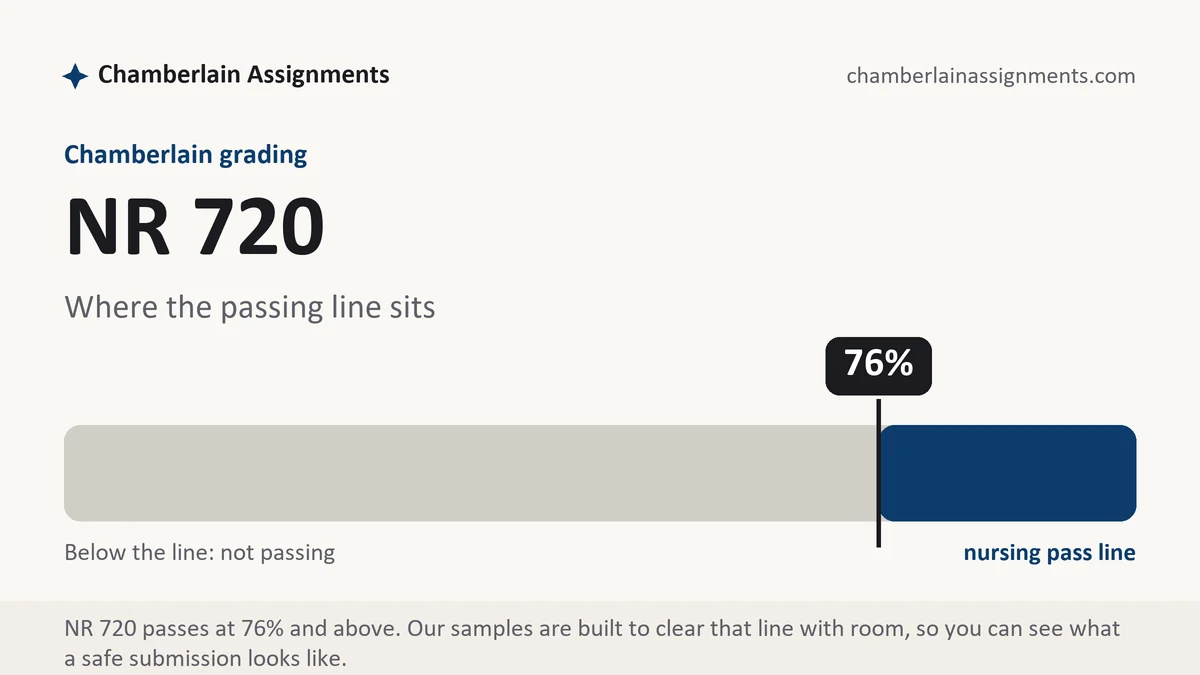
The discipline behind every paper here: the rubric is the outline, each row gets its section, one-shot discussions get the one-shot treatment, and the 76 percent floor is treated as the cliff it is. Send your week's instructions with a request and the sample matches them, revisions included.
NR 720 questions, answered
How do I map a process I only see part of?
Walk the parts you can and interview for the rest, then mark the boundaries of what you verified. A map with a clearly labeled gap is honest and usable; a map that fills the gap with assumption is neither. Faculty generally respect a writer who says where their knowledge of the pathway ends and what they inferred.
Is this the same as quality improvement?
There is overlap in tools and a real difference in aim. Quality improvement work usually runs a change and measures it. This course stops earlier, at understanding why a system produces the result it produces, and the analysis is judged on the accuracy of the explanation rather than on whether anything improved.
What data can I use if my organization restricts access?
More than you think. Publicly reported measures, your own counted observations over a defined period, schedules and staffing patterns, and documented rework are all legitimate evidence. Say how the data was gathered and over what window, keep patients unidentifiable, and treat a small hand-counted sample as what it is rather than dressing it up.