Send the exact assignment or rubric from your classroom and a custom sample written to it lands in 24 to 48 hours, the first one free. NR 722 is Chamberlain’s Role of the Educator in Facilitating Learning course. It centers on the educator as a designer of conditions for learning, where feedback, climate and restraint matter more than the quality of the explanation. Searches like "nr 722 week 4 assignment example", "NR722 sample paper", and "NR 722 week samples" land on this page.
What NR 722 is really about
By this point in the sequence the question has moved from what to teach to who you are while teaching. NR 722 treats facilitation as a role with obligations, not a friendlier style of lecturing. A facilitator arranges the conditions under which somebody learns something, which includes the silence after a question, the case that forces a decision, and the willingness to let a wrong answer stand long enough to be useful. Expert nurses find that last part genuinely difficult. You know the answer, you can see a learner heading past it, and the impulse to supply it is strong and feels like teaching. Withholding it is often what the role requires.
The rest of the course is the machinery that makes facilitation work. Feedback somebody can act on is specific, close to the performance, and about the work rather than the person. Climate decides whether anybody will risk being wrong in front of you, which decides how much learning is possible at all. Learners arrive with different preparation, different languages at home and different reasons for being there, and a design assuming one starting point quietly sorts the room. Doctoral level work asks you to argue these choices from evidence rather than from what once worked for you, and to notice when a practice you inherited has never actually been examined.
What NR 722’s assessments ask for
Work alternates between analysis of the role and the practice of it. Opening assignments often ask you to place your own teaching against the literature on facilitation, which means naming what you actually do before defending it. Middle weeks typically hand over a difficult moment: a learner who has stopped participating, a group where one voice fills the room, a performance that was unsafe and has to be addressed without ending a person. Later assignments in many sections want feedback written to a learner and then justified to a reader, so both audiences can follow the same reasoning. At this level a discussion expects argument, so a reply gains points by challenging a claim with evidence instead of adding agreement.
Where students lose points in NR 722
At this level the weak paper describes good teaching in general terms and never puts a person in it. Second is facilitation used as a label for the same lecture, where the writer says learners are guided and the plan gives them nothing to decide. Third is feedback written to protect the writer, so a serious problem arrives buried in praise and the learner leaves without knowing anything is wrong. Rubrics also punish advice offered with no evidence behind it in a doctoral course, learner differences mentioned once and never designed for, difficulty explained entirely by learner motivation, and reflection reporting emotion where the assignment asked for a decision and its reasoning.
The NR 722 drawers
NR 722 Week 1 discussion post example
Week 1 usually asks what facilitation costs an expert who already knows the answer. On request, free, 24-48h.
NR 722 Week 2 role analysis example
Week 2 often examines what the educator role obliges you to do beyond explaining well. On request, free, 24-48h.
NR 722 Week 3 teaching philosophy statement example
Week 3 typically asks for beliefs about learning a stranger could see in your practice. On request, free, 24-48h.
NR 722 Week 4 facilitation case analysis example
Week 4 commonly hands over a stalled group and asks what you would arrange. On request, free, 24-48h.
NR 722 Week 5 feedback exchange write-up example
Week 5 generally asks for feedback written to a learner and justified to a reader. On request, free, 24-48h.
NR 722 Week 6 learner difficulty case study example
Week 6 in many sections takes a struggling learner and asks what the difficulty actually is. On request, free, 24-48h.
NR 722 Week 7 inclusive design plan example
Week 7 frequently asks which learners your default design quietly leaves behind. On request, free, 24-48h.
NR 722 Week 8 scholarly synthesis paper example
Week 8 tends to argue your practice from the literature rather than from experience alone. On request, free, 24-48h.
Your classroom shows something else?
Chamberlain University revises courses; week counts and deliverables shift between terms. Send what your classroom shows and the desk matches it exactly.
Using a NR 722 sample the right way
Read a sample here for what the educator does not do. Find the point where the writer could have supplied an answer and instead set a condition, then follow what the learner did next, because that sequence is the argument this course wants. In the feedback samples, notice how specific the first sentence is and how quickly it points at the work rather than the person. Then rewrite around your own learners and your own setting, since the room decides what restraint costs. A sample can show the shape of a facilitated exchange; the people in it have to be yours.
How these samples are written
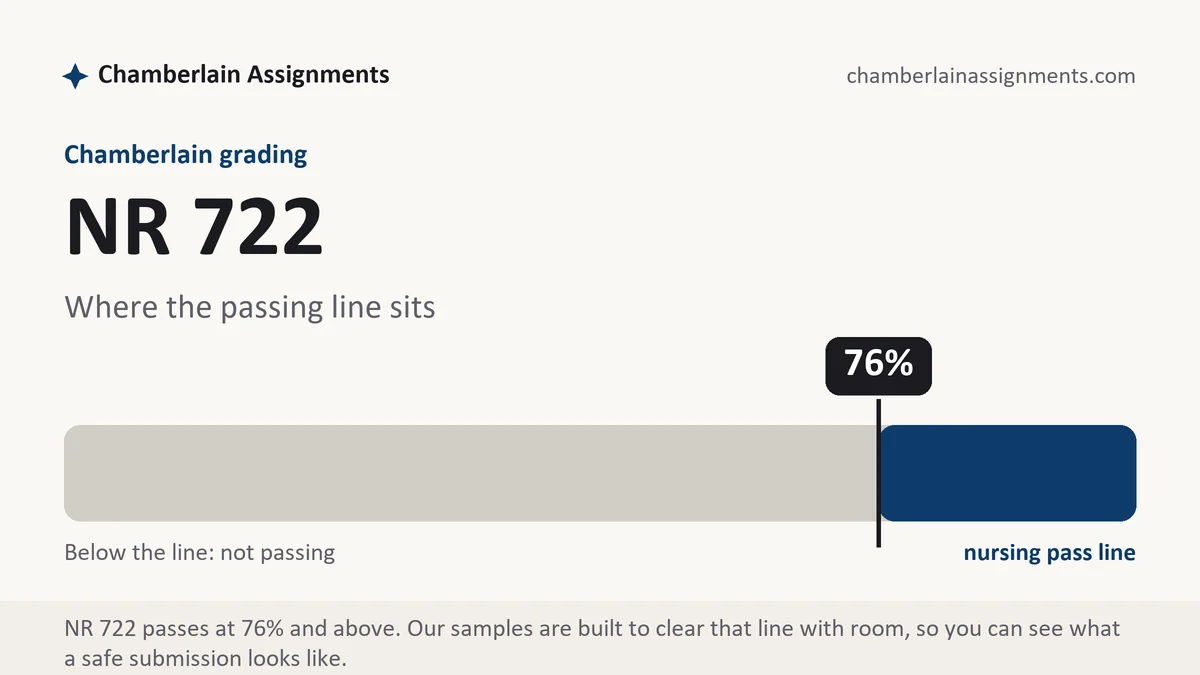
The discipline behind every paper here: the rubric is the outline, each row gets its section, one-shot discussions get the one-shot treatment, and the 76 percent floor is treated as the cliff it is. Send your week's instructions with a request and the sample matches them, revisions included.
NR 722 questions, answered
Is facilitation just discussion?
No, and treating it that way is why so many sessions stall. Facilitation means designing what a learner has to do and then protecting the space where they do it, which can look like a case, a simulation, a problem with information missing, or a decision under time pressure. Discussion is one vehicle, and it works only when something is at stake.
How do I give hard feedback without damaging a learner?
Separate the performance from the person and say the problem first, plainly, with the observation attached. Vagueness is the unkind option, because it leaves somebody repeating an error while believing they are fine. Then give one thing to change and a way to practice it. Warmth belongs in how you say it, not in whether you say it.
Does everything need a citation at this level?
Any claim about what works does. Doctoral readers accept experience as illustration and not as evidence, so pair the incident with something published that explains or complicates it. Papers lose ground in the recommendation section, where a lifetime of practice suddenly speaks alone and the argument stops being scholarship and becomes advice.