Send the exact assignment or rubric from your classroom and a custom sample written to it lands in 24 to 48 hours, the first one free. PA-510 is Chamberlain’s Comprehensive Clinical Module Dermatology course. It centers on putting a skin finding into words precise enough that someone who never saw it reaches the same short list. Searches like "pa 510 week 4 assignment example", "PA510 sample paper", and "PA-510 week samples" land on this page.
What PA-510 is really about
PA-510 is the one module where the finding sits on the surface, in plain sight, and the difficulty is not access but language. A rash is available to everyone in the room. What separates a marked answer from an unmarked one is whether the writer owns the vocabulary that turns it into data: primary lesion or secondary change, flat or raised, fluid-filled or solid, the edge, the scale, the arrangement of several lesions against each other, and where on the body they sit. Faculty read the description first. A diagnosis resting on a vague description earns very little, because nothing underneath it holds.
The other half of the module is the photograph. Much of this specialty now moves as an image, and assignments are built on that: a picture with a history attached, or a picture with nothing attached. A camera carries color, border and arrangement reasonably well. It loses palpation, temperature, whether a lesion blanches, how the surface felt, and the rest of the body it belongs to. Written work is expected to say which of those are absent and what they would have settled. Sections also press on recording findings accurately across skin tones, where redness is not the dependable sign a textbook plate suggests.
What PA-510’s assessments ask for
Sections vary, but the pattern holds. Week 1 is a discussion. From there most weeks pair an image set or a written vignette with a demand for description ahead of interpretation, and many rubrics award the description in a row of its own, separate from the short list. Expect at least one assignment where a photograph arrives without the history and you are marked on what can and cannot be concluded from it, one on a lesion that needs a decision about sampling, where the written justification carries the points rather than the choice itself, and one on recording the same finding across different skin tones. APA citation of current specialty references is graded on most written pieces.
Where students lose points in PA-510
Points go first to the answer that names a condition in its opening line and then describes backwards to defend it. Graders see it immediately, because the description contains only the features that fit. Second is vocabulary the writer half-owns: papule, plaque and nodule swapped around, scale and crust treated as one thing, an arrangement reported as a distribution. A term is either technical or it is decorative, and a rubric row for morphology finds the difference. Third is the answer that treats an image as a complete examination, offering a firm read on a photograph with no history, no palpation and no view of the rest of the body. Confidence with nothing under it reads worse than a short list with its limits stated.
The PA-510 drawers
PA-510 Week 1 discussion post example
Week 1 usually opens on why a skin finding gets described before it gets named. On request, free, 24-48h.
PA-510 Week 2 lesion morphology description example
Week 2 often supplies a single lesion and marks the primary and secondary terms applied to it. On request, free, 24-48h.
PA-510 Week 3 distribution pattern analysis example
Week 3 commonly moves from one lesion to where several sit on the body and how they are arranged. On request, free, 24-48h.
PA-510 Week 4 clinical photograph critique example
Week 4 tends to hand over an image with the history withheld, then grade what it will and will not support. On request, free, 24-48h.
PA-510 Week 5 skin tone description audit example
Some sections use Week 5 for the same finding across skin tones, where color words carry differently. On request, free, 24-48h.
PA-510 Week 6 pigmented lesion evaluation example
Week 6 frequently sets a pigmented lesion and marks the features recorded rather than the verdict reached. On request, free, 24-48h.
PA-510 Week 7 biopsy site justification example
Week 7 often wants the written reasoning behind where and how a sample would be taken. On request, free, 24-48h.
PA-510 Week 8 teledermatology referral brief example
The closing week regularly asks what an image-based consult can settle and what it has to send onward. On request, free, 24-48h.
Your classroom shows something else?
Chamberlain University revises courses; week counts and deliverables shift between terms. Send what your classroom shows and the desk matches it exactly.
Using a PA-510 sample the right way
Read a sample for the order of its sentences. The useful part is watching a writer hold the name back while features accumulate, and seeing which features earn a mention at all. Note where the sample records something as absent, since absent findings do real work here and are the hardest thing to produce from a blank page. Notice how few loose adjectives survive an edited sample, since a term either narrows the list or takes up room. Your classroom will use its own images and your section may grade on a rubric row this one does not carry, so what transfers is the discipline of the description rather than any particular case.
How these samples are written
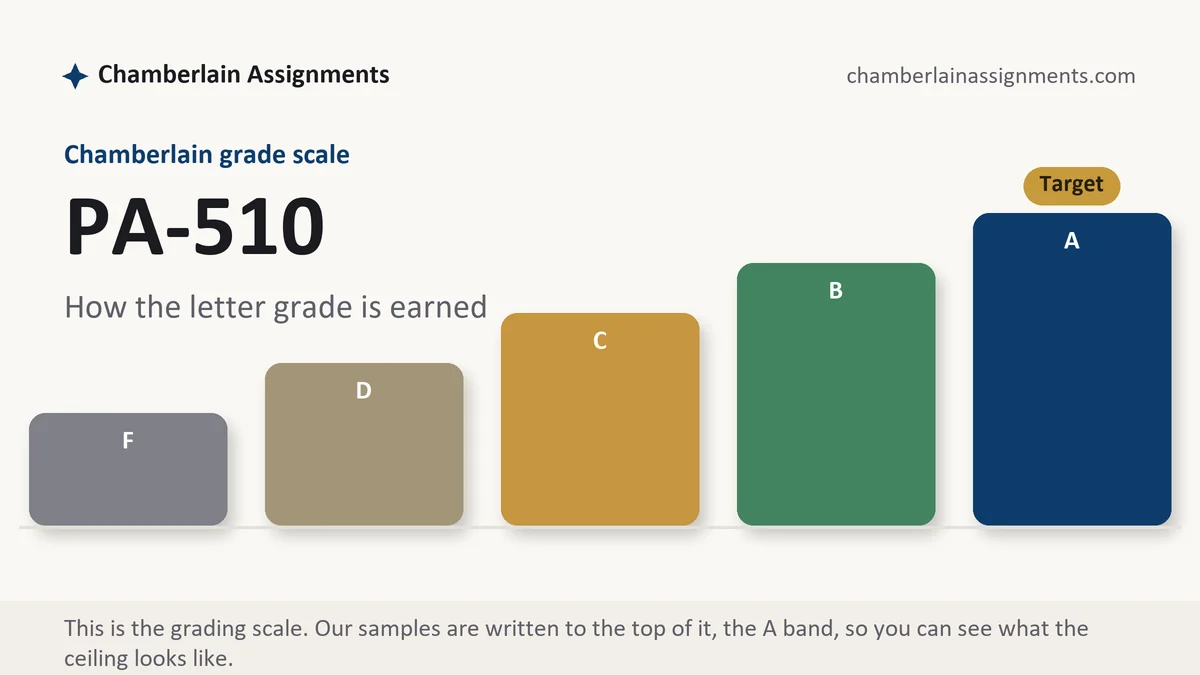
The discipline behind every paper here: the rubric is the outline, each row gets its section, one-shot discussions get the one-shot treatment, and the 76 percent floor is treated as the cliff it is. Send your week's instructions with a request and the sample matches them, revisions included.
PA-510 questions, answered
My assignment is a photograph and one line of history. What is there to write?
That is the assignment rather than an oversight. The written work in that case is an inventory of what the image supports, a short list it is consistent with, and a statement of what a photograph cannot supply: palpation, whether the lesion blanches, the rest of the body, and the course over time. Rubrics on image-only tasks usually award points for naming those gaps explicitly.
Do I need specialty sources, or will a general medicine text do?
Most sections want current specialty references behind the descriptive terms and the sampling decisions, and they mark citations on the same rubric row as the writing. A general text tends to give the classic presentation only, which is what produces a description repeating the textbook instead of the image in front of you. Send whatever reference list your classroom posted with the assignment.
Can a sample match my images if I have not sent them?
Send them, with the prompt and the rubric. The sample gets assembled on whatever your own classroom posted, because the value here sits in the descriptive sequence rather than in the condition. Two pictures can carry one diagnosis and still need different write-ups, since arrangement, distribution and whatever the camera left out change what there is to say about them.