Send the exact assignment or rubric from your classroom and a custom sample written to it lands in 24 to 48 hours, the first one free. PA-528 is Chamberlain’s Comprehensive Clinical Module Neurology course. It centers on arguing from a set of findings to the level and side a lesion must occupy, then choosing the study that can confirm it. Searches like "pa 528 week 4 assignment example", "PA528 sample paper", and "PA-528 week samples" land on this page.
What PA-528 is really about
Neurology inverts the order most modules teach. The question is not what disease this is but where it has to be, and the answer comes from findings that only make sense in combination. Weakness with brisk reflexes points to a different level than weakness with wasting and twitching. A deficit on one side of the face with a deficit on the other side of the body places the problem in the brainstem and almost nowhere else. Cortex, brainstem, cord, root, plexus, nerve, junction and muscle each produce a signature, and eight weeks go into reading those signatures apart. None of them can be told from a single sign in isolation, which is why the combination carries the argument.
Time is the second axis here, and it does as much work as anatomy. Something that arrived complete in a second is vascular until proved otherwise; something that built over two minutes and then stopped is behaving like a seizure or a migraine; something that has crept along for eighteen months is degenerative. Two of those three are settled by the history alone, before anyone has been examined. Assignments keep asking for both readings at once, a level and a time course, because together they narrow a list further than either manages alone. Imaging enters late and deliberately, as an instrument aimed at a level you have already argued for, carrying a question the radiologist can actually answer.
What PA-528’s assessments ask for
Assignments in most sections give findings and withhold the diagnosis. An early piece usually lists deficits and asks for the single level accounting for all of them, together with the findings that exclude the levels above and below. A cranial nerve task commonly follows, where the combination of nerves involved is the whole argument and a map is often the expected form. The middle of the session tends to bring an event description, a seizure or a spell recounted by a witness, and asks what the sequence says about where it started. Later work often includes a stroke case matched to a vascular territory, a time course argued in writing, and a request for imaging that names the level and the question. Discussions carry visible points every week.
Where students lose points in PA-528
A diagnosis reached without a level is where the deductions start. Naming a condition in the opening paragraph and then listing findings that would fit it reverses the reasoning being graded, and faculty say so in feedback every session. Second is a level asserted from one finding when the others contradict it, which usually means the reflexes or the sensory boundary were read past. Third is an imaging request with no question inside it, since a study ordered without a level or a suspicion produces a report nobody can use. Fourth is a time course left out altogether. Findings copied from the prompt without being interpreted, and a witness account summarized rather than sequenced, take the marks that remain.
The PA-528 drawers
PA-528 Week 1 discussion post example
Week 1 usually opens on why a level is settled before a disease is named. On request, free, 24-48h.
PA-528 Week 2 lesion localization exercise example
Week 2 often supplies a set of deficits and asks for the one place accounting for all of them. On request, free, 24-48h.
PA-528 Week 3 cranial nerve deficit map example
Week 3 in many sections works from the combination of nerves involved to the structure they pass through. On request, free, 24-48h.
PA-528 Week 4 motor neuron brief example
Week 4 commonly separates weakness with brisk reflexes from weakness with wasting. On request, free, 24-48h.
PA-528 Week 5 seizure semiology write-up example
Week 5 typically turns a witness account into a sequence and asks where the event began. On request, free, 24-48h.
PA-528 Week 6 episodic symptom timeline example
Week 6 often asks what the speed of onset by itself rules in and out. On request, free, 24-48h.
PA-528 Week 7 stroke syndrome correlation example
Week 7 usually matches a pattern of deficits to the territory that supplies it. On request, free, 24-48h.
PA-528 Week 8 neuroimaging request brief example
Week 8 in many sections writes the study request, with the level named and a question attached. On request, free, 24-48h.
Your classroom shows something else?
Chamberlain University revises courses; week counts and deliverables shift between terms. Send what your classroom shows and the desk matches it exactly.
Using a PA-528 sample the right way
Read an example for the order of its claims. Notice that the level arrives before any disease name, that each finding is tied to what it excludes as well as what it supports, and that the imaging paragraph carries a question rather than a request for pictures. Watch how a witness account is turned into a sequence with times in it, and note the sentence naming what the examination cannot settle by itself. The cases in these samples are invented and constructed so the findings agree with one another, which is what makes a localization followable. Take the shape of the argument and supply your own reasoning.
How these samples are written
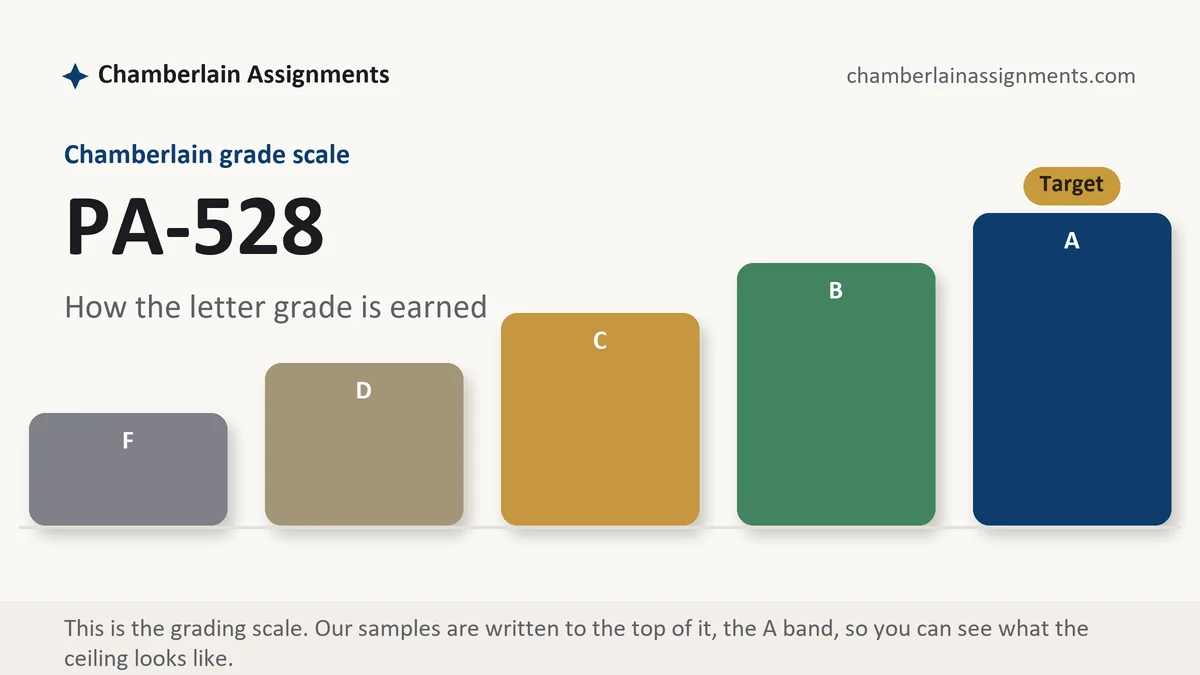
The discipline behind every paper here: the rubric is the outline, each row gets its section, one-shot discussions get the one-shot treatment, and the 76 percent floor is treated as the cliff it is. Send your week's instructions with a request and the sample matches them, revisions included.
PA-528 questions, answered
My prompt lists findings that seem to point two different places. Is that a mistake?
Usually not. Prompts in this module are often built with one finding that appears to conflict, because deciding which observation is load bearing is the skill being marked. A sample handles that openly, saying which finding it is weighting and why the other can be accounted for another way, rather than silently dropping the inconvenient half and hoping nobody checks.
Does the sample include images?
No, and assignments here rarely need them. What a sample carries instead is the request itself: the level under examination, the question the study is meant to answer, and the reason for that study rather than another. Where your prompt supplies a report to interpret, send the wording, and the sample works from the same description your grader has.
How closely does the sample follow my classroom template?
As closely as you tell it to. Sections differ on how findings are organized and how much of the examination is expected in writing, so attach the template or the rubric alongside the prompt. The desk fits the argument to your form rather than a generic one, which matters here because the order findings appear in is part of what gets marked.