Send the exact assignment or rubric from your classroom and a custom sample written to it lands in 24 to 48 hours, the first one free. NR 224 is Chamberlain’s Fundamentals: Skills course. It centers on the reasoning underneath a procedure, written out step by step, while the skill itself is signed off in the lab. Some program versions carry this course as NR 229; the same drawers apply. Searches like "nr 224 week 4 assignment example", "NR224 sample paper", and "NR 224 week samples" land on this page.
What NR 224 is really about
NR 224 looks like the course with no writing in it, which is why the written half surprises people. Learning to irrigate a wound or move a patient up a bed is watched and signed off in the lab by an instructor, and no part of that belongs to anybody else. What comes back to the classroom is the account: why the order of the steps is the order it is, what each one prevents, and what you would do the moment something in the room stopped matching the procedure. That question has a right answer and it is not in the video. It sits in the reason a step exists, which is the part people skip when they learn a skill by imitation.
So the writing here is unusually literal and unusually strict. A step described without its reason is half an answer, and a reason offered with no source behind it is an opinion about hygiene. This is also where documentation starts to matter, because a procedure you performed and never charted is one a reader has no way to credit, and the charting habits built now follow you into every clinical course afterwards. Expect prompts asking what you assessed before you began, what you watched for while you worked, and what you would report and to whom. The last of those separates a first-year answer from a competent one far more sharply than the technique does.
What NR 224’s assessments ask for
Weekly work usually pairs the skill of the week with a written account of it. Procedure assignments want the steps in order with a rationale attached to each one, and they generally expect that reason to come from your text or another authority rather than from what somebody demonstrated on a bench. Safety prompts hand you a room where something is wrong, a rail down, a line unlabeled, a patient who has decided to walk, and ask what you would do first and why that comes first. Documentation exercises ask for the same event charted in the vocabulary a record actually uses. Discussions early in the week often circle an error that reached a patient, and the reply that earns points names the step where it became possible.
Where students lose points in NR 224
The costly answer is the recipe: numbered steps copied faithfully with nothing said about why any of them exist, which reads as transcription rather than understanding. Second is the safety answer that reports what happened and decides nothing, since the prompt asked what you would do first and a paragraph of description never arrives there. Third is charting written as narrative, where an opinion about the patient turns up in a record that should carry what you observed. Beyond that, hand hygiene and identification left out because they felt too obvious to write, sterile technique described in general terms rather than at the point where it can break, and a rationale about comfort where the real reason is infection all cost points.
The NR 224 drawers
NR 224 Week 1 discussion post example
Week 1 usually asks what makes a skill safe rather than merely smooth. On request, free, 24-48h.
NR 224 Week 2 asepsis write-up example
Week 2 often starts where every procedure starts, with what stops an infection traveling. On request, free, 24-48h.
NR 224 Week 3 procedure rationale example
Week 3 typically asks for one skill written out with a reason under each step. On request, free, 24-48h.
NR 224 Week 4 vital signs write-up example
Week 4 commonly wants measurements taken, recorded and explained when one of them looks wrong. On request, free, 24-48h.
NR 224 Week 5 safety scenario response example
Week 5 in many sections puts you in a room where something is already unsafe. On request, free, 24-48h.
NR 224 Week 6 wound care write-up example
Week 6 usually moves to a dressing change where the sterile field decides the mark. On request, free, 24-48h.
NR 224 Week 7 charting exercise example
Week 7 frequently asks for the same event written the way a record would hold it. On request, free, 24-48h.
NR 224 Week 8 skills reflection example
Week 8 tends to ask which skill still feels wrong in your hands and why. On request, free, 24-48h.
Your classroom shows something else?
Chamberlain University revises courses; week counts and deliverables shift between terms. Send what your classroom shows and the desk matches it exactly.
Using a NR 224 sample the right way
Use a sample to see how tightly a reason can be tied to a step without the write-up turning into a lecture. Notice that the rationale is usually one clause, that it names what would go wrong rather than what should go right, and that the checks nobody thinks worth mentioning get mentioned anyway. Then write your own around the procedure your week actually covers, since equipment and sequence differ between sections and between terms. Your lab performance stays yours in every sense. What a sample can carry is the shape of the account you write afterwards.
How these samples are written
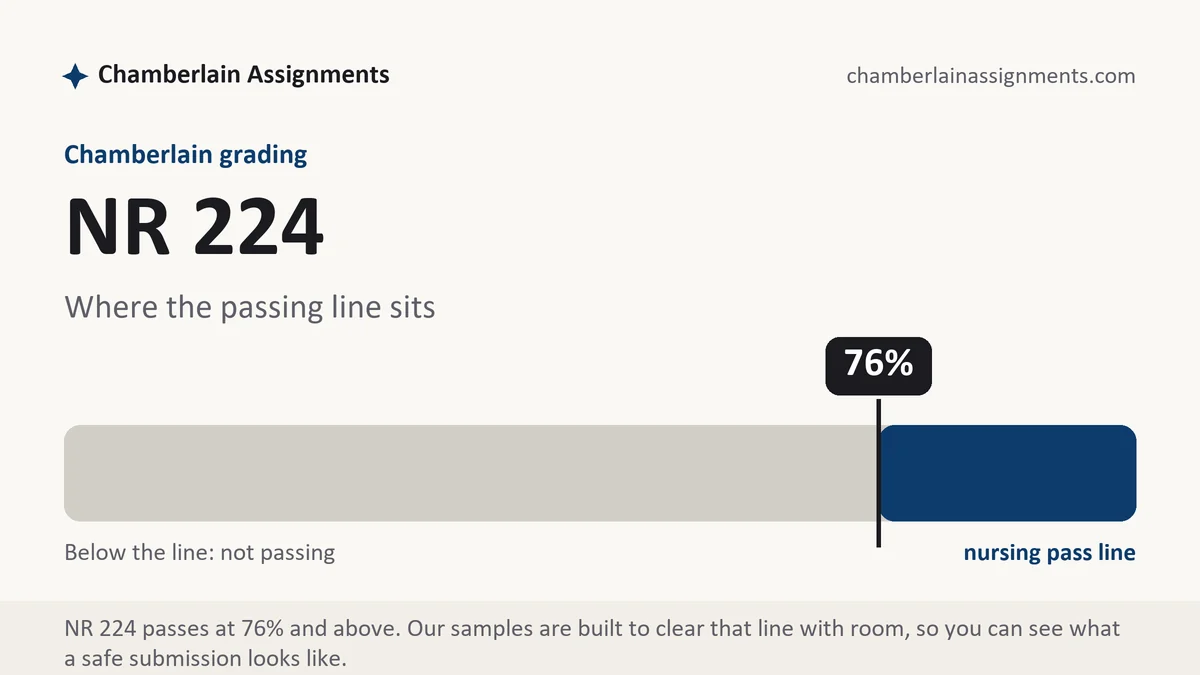
The discipline behind every paper here: the rubric is the outline, each row gets its section, one-shot discussions get the one-shot treatment, and the 76 percent floor is treated as the cliff it is. Send your week's instructions with a request and the sample matches them, revisions included.
NR 224 questions, answered
Can somebody complete my skills check-off paperwork?
No, and nothing here tries to. A check-off is watched and signed by an instructor, and any log, competency record or form with a signature line on it is yours to complete. What a sample covers is the written work around the lab: the procedure account, the rationale, the safety analysis and the charting exercise your classroom sets.
How much detail does a rationale need?
Usually one clause per step, naming what that step prevents. Cleaning outward from the incision prevents dragging organisms back across the wound, and that sentence is worth more than a paragraph about asepsis in general. If a step has no reason you can state in your own words, that is the one to look up before you submit.
My section teaches the steps differently from the sample.
Follow your section every time. Sequence, equipment and terminology vary between schools, terms and lab instructors, and a grader marks the version taught in your lab. Send the checklist or template your classroom uses when you ask, and the account is written against that rather than against a generic procedure.