Send the exact assignment or rubric from your classroom and a custom sample written to it lands in 24 to 48 hours, the first one free. NR 306 is Chamberlain’s Health Assessment course. It centers on producing one complete examination record where every region on the template is answered, including the ones that turned up nothing. Some program versions carry this course as NR 514; the same drawers apply. Searches like "nr 306 week 4 assignment example", "NR306 sample paper", and "NR 306 week samples" land on this page.
What NR 306 is really about
On a unit you assess what the situation calls for. A patient admitted with chest pain gets a cardiac and respiratory examination, and nobody expects the cranial nerves to appear anywhere in the note. NR 306 removes that permission. The examination it grades is exhaustive by design, moving through every region a template names whether or not the person has anything wrong with that region, and the completeness is the point rather than a side effect. Experienced nurses find this the hardest adjustment in the course, because clinical judgment has trained them to skip, and skipping is exactly what the rubric counts. A region missing from the document is read as a region never examined.
That is why the negative finding carries so much weight here. Recording that there was no swelling behind the knees, no distension of the neck veins, no tenderness over the sinuses, is not padding; it is the only evidence a reader has that those things were looked for at all. The second rule is order. The template decides the sequence, not your sense of what matters about this person, so a beautifully written cardiac section placed where the skin section belongs still reads as a document assembled from memory afterwards. Fill the rows in the order they are printed, keep the wording clinical, and the write-up starts to look like an examination that happened.
What NR 306’s assessments ask for
Weekly work in many sections advances one region at a time and then gathers them. Early assignments typically take a single body system, ask for it examined on a consenting adult and reported inside the classroom template, with the side, the site and the measurement stated wherever the finding allows one. Middle weeks add systems until the document runs long enough that repetition and ordering become a real problem to manage. Late in the session a full head to toe is usually expected in one piece, written from a single encounter rather than stitched together from the earlier ones. Discussion prompts near the start of the week usually turn on technique, and the reply that scores names a maneuver instead of admiring the post it answers.
Where students lose points in NR 306
The reliable loss in NR 306 is the blank. A row nobody filled, a system nobody mentioned, a region summarized as unremarkable with nothing under it: each reads to a grader as an examination that stopped early. Close behind is the write-up that reports only what was interesting, which is the floor habit arriving intact, and it costs the coverage rows even when the interesting part is described well. Third is the borrowed phrase, since template language copied from a textbook tends to describe a body nobody examined and shows up as findings that could not all belong to one person. Findings recorded without a side, measurements replaced by adjectives, and regions listed in an order the template never used take smaller amounts steadily.
The NR 306 drawers
NR 306 Week 1 discussion post example
Week 1 typically asks what an academic examination is for when you already assess daily. On request, free, 24-48h.
NR 306 Week 2 skin and nails write-up example
Week 2 often starts where findings can be seen without touching anything. On request, free, 24-48h.
NR 306 Week 3 head and neck write-up example
Week 3 in many sections crowds a small area with structures worth naming exactly. On request, free, 24-48h.
NR 306 Week 4 respiratory assessment example
Week 4 commonly wants breath sounds located by landmark rather than described in general. On request, free, 24-48h.
NR 306 Week 5 cardiovascular assessment example
Week 5 usually adds pulses and the measurements that have to accompany them. On request, free, 24-48h.
NR 306 Week 6 abdominal assessment example
Week 6 generally fixes the order of the four steps and marks any rearrangement. On request, free, 24-48h.
NR 306 Week 7 neurological assessment example
Week 7 frequently reaches the systems a busy shift almost never asks anyone to test. On request, free, 24-48h.
NR 306 Week 8 head to toe write-up example
Week 8 tends to want every region in one document from one encounter. On request, free, 24-48h.
Your classroom shows something else?
Chamberlain University revises courses; week counts and deliverables shift between terms. Send what your classroom shows and the desk matches it exactly.
Using a NR 306 sample the right way
Read a sample here for its coverage before its prose. Count the regions it reaches, notice how quickly each one is disposed of, and watch how a negative is written so that it takes a line rather than a paragraph. That density is the thing worth copying, because the common failure is a document that spends its length on two systems and runs out. Then examine your own consenting adult and write your own version, since the findings belong to that encounter and any consent form your section requires is yours to keep. What a sample transfers is pace and completeness, not content.
How these samples are written
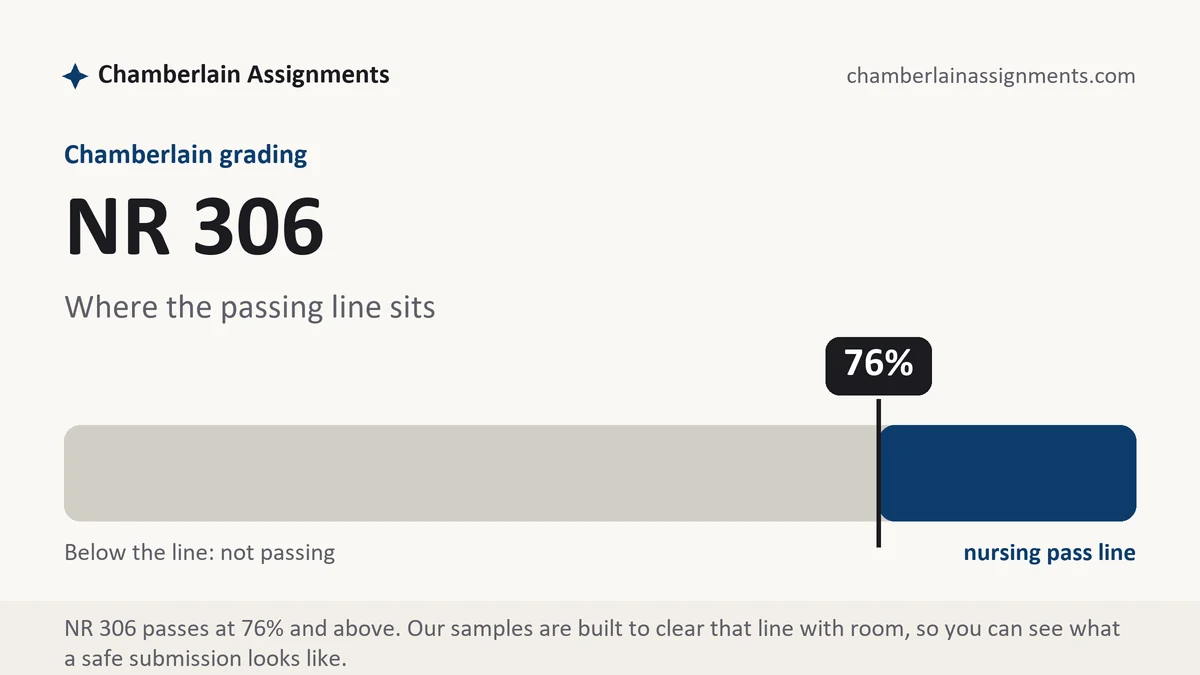
The discipline behind every paper here: the rubric is the outline, each row gets its section, one-shot discussions get the one-shot treatment, and the 76 percent floor is treated as the cliff it is. Send your week's instructions with a request and the sample matches them, revisions included.
NR 306 questions, answered
How is this different from the health history course?
NR 305 sits on the interview. Its material is what a person tells you, gathered by asking well, and its write-up reports an account. NR 306 sits on the examination. Its material is what you elicit yourself, region by region, and its write-up reports observations. The two courses overlap in vocabulary and in almost nothing else, so a history template will not carry an examination assignment.
Do I really have to write out the findings that were normal?
Yes, and they are most of the document. A negative is what proves the region was reached, so no edema at the ankles and no lymph nodes palpable under the jaw each earn their line. What a grader cannot do is credit an examination they cannot see, and silence about a region reads the same as an omission whether or not you actually looked.
Who should I examine, and can a sample use them?
Your section decides, and it is normally a consenting adult rather than a patient from work. Ask, explain what the examination involves, and stop the moment they want to stop. A sample can be written to your template and your instructions so the shape is right, but the findings have to come from the body you actually examined, because those are the part of this course that is yours.