Send the exact assignment or rubric from your classroom and a custom sample written to it lands in 24 to 48 hours, the first one free. NR 533 is Chamberlain’s Financial Management in Healthcare Organizations course. It centers on money as the subject rather than the limit, from a variance somebody must explain to a business case that has to earn its capital. Searches like "nr 533 week 4 assignment example", "NR533 sample paper", and "NR 533 week samples" land on this page.
What NR 533 is really about
In most nursing courses money is the reason you cannot do something. In NR 533 it is the thing you are writing about. The course expects you to read a budget the way a chief nursing officer reads one, which means knowing what each line is, where the figure came from, and which parts of it you actually control. That distinction runs through the whole session. Volume you did not choose, a wage rate set above you and a supply price the system negotiated are different from hours you scheduled and overtime you approved, and a variance report is only useful once those causes have been separated. Separating them is most of the work in a variance write-up.
The second half of the course asks you to spend rather than explain. A business case here is persuasion with arithmetic inside it: what the proposal costs to start, what it costs every year afterwards, what it returns in money or avoided cost, when the two lines cross, and what happens if the assumptions turn out wrong. Capital and operating are kept apart on purpose, because equipment approved once and a position funded forever are different asks with different approvals behind them. Rubrics reward writing that admits its weakest assumption before a finance reader has the pleasure of finding it. The strongest cases also say what they would do at half the projected benefit, because a reader with a calculator will ask.
What NR 533’s assessments ask for
Assignments in NR 533 tend to hand you figures and ask what they mean. Early weeks work on reading: a budget broken into its parts, a variance split by volume, rate and use, a cost per patient day rebuilt from the inputs that produced it. Middle weeks move to construction, where you build an operating budget for a unit, justify the staffing dollars inside it and defend the assumptions you chose. Later work is a proposal, a case for a position, a piece of equipment or a service, written for people who will approve or refuse it. Discussions usually stay practical, and a strong reply questions a classmate's assumption instead of praising the format. Praising a format is the reply that earns nothing.
Where students lose points in NR 533
The first way to lose points is to report a variance without a cause. A table showing the unit ran over and a sentence saying volume was high is a description, while the rubric is asking which part of the gap came from volume, which from rate and which from hours you approved. The second is the business case with only benefits in it, where the equipment saves time, improves safety and pays for itself, and no year carries an expense line. The third is confusing capital with operating, which turns a one-time purchase into a permanent commitment and tells a finance reader you have never read a budget. Rounded guesses presented as sourced figures, and a payback claim with no year attached, finish the damage.
The NR 533 drawers
NR 533 Week 1 discussion post example
Week 1 often asks which lines on a unit budget a manager truly controls. On request, free, 24-48h.
NR 533 Week 2 budget variance analysis example
Week 2 typically splits one month's overspend into the separate causes sitting behind it. On request, free, 24-48h.
NR 533 Week 3 cost per case worksheet example
Week 3 commonly rebuilds the cost of one service from the inputs that make it. On request, free, 24-48h.
NR 533 Week 4 operating budget draft example
Week 4 often asks you to build a unit's annual expense budget line by line. On request, free, 24-48h.
NR 533 Week 5 business case example
Week 5 usually wants a funded proposal with the payback point stated plainly. On request, free, 24-48h.
NR 533 Week 6 capital request write-up example
Week 6 frequently separates a one-time purchase from the recurring costs that follow it. On request, free, 24-48h.
NR 533 Week 7 reimbursement brief example
Week 7 in many sections asks how payer mix changes what a service actually earns. On request, free, 24-48h.
NR 533 Week 8 budget defense presentation example
Week 8 often closes with the figures presented to people who can refuse them. On request, free, 24-48h.
Your classroom shows something else?
Chamberlain University revises courses; week counts and deliverables shift between terms. Send what your classroom shows and the desk matches it exactly.
Using a NR 533 sample the right way
Trace the arithmetic in a sample before you read its prose. Follow one figure from where it enters to where the conclusion uses it, and check that it does not change along the way, because that single habit fixes most of what goes wrong in financial writing. Notice how the strongest samples state an assumption and immediately say what happens if it is wrong. Then rebuild the whole thing on figures from your own setting or a clearly sourced comparable, since a business case is judged on whether its inputs are believable. Inputs a reader can look up beat inputs a reader has to accept.
How these samples are written
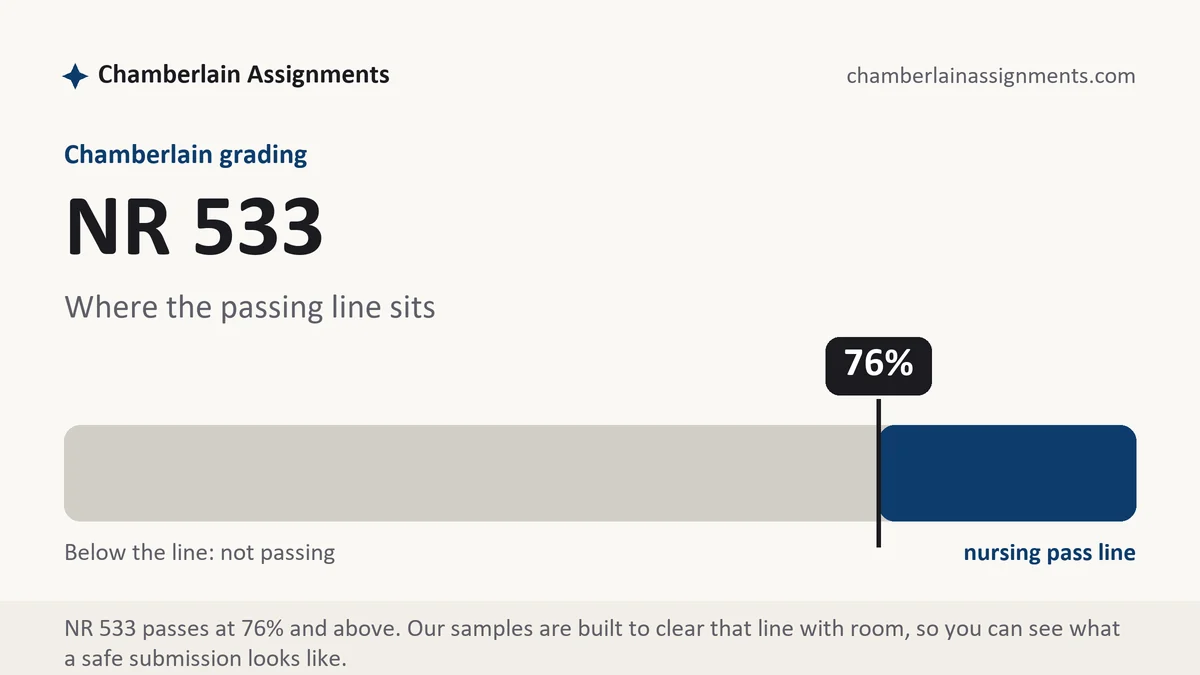
The discipline behind every paper here: the rubric is the outline, each row gets its section, one-shot discussions get the one-shot treatment, and the 76 percent floor is treated as the cliff it is. Send your week's instructions with a request and the sample matches them, revisions included.
NR 533 questions, answered
Can I use my employer's real budget numbers?
Only what you are permitted to share. Strip identifiers, keep the figures at a level your organization would not object to, and say in the paper that they are internal and generalized. Anything your employer or a site would have to release or put a signature on is yours to obtain and never ours to produce, and published benchmarks cover the rest.
I have never built a budget. Where do samples actually help?
In the structure, which is the part nobody teaches on a unit. Seeing where salary dollars sit, how benefits and overtime attach to them, and how supply and equipment lines are kept separate makes a first attempt far less blind. The arithmetic then follows your own setting, and the assumptions stay yours to defend in front of a grader.
How do I argue a proposal that will not save money?
Say so first, then argue on the ground it actually wins. Plenty of approved requests cost money and are funded because they reduce a risk, meet an obligation or protect a service the organization has already committed to. What fails is a paper that manufactures savings to hide the cost, since the first reader with a calculator finds it and stops trusting the rest.