Send the exact assignment or rubric from your classroom and a custom sample written to it lands in 24 to 48 hours, the first one free. PA-602 is Chamberlain’s PA Prof Prac Seminar IV course. It centers on the seminar about what went wrong and the conversation afterward, where the deliverable is the account given to a patient and a supervisor. Searches like "pa 602 week 4 assignment example", "PA602 sample paper", and "PA-602 week samples" land on this page.
What PA-602 is really about
Nobody is a good enough clinician to avoid this course's material. Missed findings, wrong turns, a patient who leaves angry, a request that cannot be granted and a family that wants a different answer are ordinary features of practice, and PA-602 treats them as work rather than as scandal. The seminar is built on two objects. The first is the reconstruction: what was known at each point, what was done, and where the path forked. The second is the conversation that follows, with the patient, with the supervising physician, and sometimes with a department that keeps records. Both are written down here, and both are marked, which is unusual enough that students underestimate the second one.
The reconstruction is marked on honesty about sequence. Faculty want the order in which information arrived, because a decision can look indefensible in hindsight and reasonable at the time, and telling those apart is the whole analytic task. The conversation is marked on wording. A sentence admitting what happened without a defense buried in its second clause is harder to produce than students expect, and rubrics here often quote the exact phrasing back. Blame is not the currency. A submission landing on a person, including on the writer, and stopping there scores below one that finds the point where a different action was available and says plainly what that action was and who could have taken it.
What PA-602’s assessments ask for
Most sections pair a discussion with one written piece each week, and the written pieces are short and specific. Expect a case where a finding was missed and the assignment is a timeline showing what was known when. Expect a drafted conversation, written as actual sentences rather than as a summary, for a patient who has to be told something nobody wants to say. A refusal usually appears somewhere in the term, a request for something the clinician will not provide, marked on whether the reason reaches the patient rather than on whether the answer was correct. Later weeks often add the supervising physician: the same event, told upward, in the form a setting would use. A written reply to a complaint is common near the end.
Where students lose points in PA-602
The costliest submission blames the system in its first paragraph and never comes back. Understaffing and a broken schedule can both be true and still leave the question of what this clinician could have done, which is what the rubric asks. Second is hindsight dressed as analysis, where the timeline is written from the answer backwards so every earlier step looks negligent, and faculty read that as a reconstruction nobody performed. Third is the apology with a defense inside it. One clause admitting the event and a second explaining why it was reasonable reads, to a patient and to a grader, as no apology at all. Vagueness costs as well: an event described without a time, a person or a decision cannot be analyzed.
The PA-602 drawers
PA-602 Week 1 discussion post example
Week 1 typically opens on how a bad outcome and a bad decision come apart. On request, free, 24-48h.
PA-602 Week 2 error sequence timeline example
Week 2 in many sections wants the event laid out in the order information actually arrived. On request, free, 24-48h.
PA-602 Week 3 miss reconstruction example
Week 3 usually takes a finding nobody caught and asks where the path forked. On request, free, 24-48h.
PA-602 Week 4 correction conversation draft example
Week 4 often asks for the correcting conversation written as sentences somebody could say aloud. On request, free, 24-48h.
PA-602 Week 5 refusal encounter write-up example
Week 5 commonly hands over a request that will be declined and marks whether the reason reaches the patient. On request, free, 24-48h.
PA-602 Week 6 apology wording review example
Week 6 generally puts a draft apology under review for the defense hiding in its second clause. On request, free, 24-48h.
PA-602 Week 7 supervising physician debrief example
Week 7 frequently reports the same event upward, in the form a supervising physician expects. On request, free, 24-48h.
PA-602 Week 8 complaint response letter example
Week 8 in several sections answers a written complaint without conceding everything or dismissing it. On request, free, 24-48h.
Your classroom shows something else?
Chamberlain University revises courses; week counts and deliverables shift between terms. Send what your classroom shows and the desk matches it exactly.
Using a PA-602 sample the right way
Read the drafted conversations word by word. The value in this shelf is not the case, which will differ from yours, but the sentence construction: what is stated first, what is left out, where the pause falls, and how a writer says something is being looked into without promising a finding. Compare those sentences against the ones you would write cold, and the difference is where the points live. For the timelines, read the column of what was known rather than the column of what was done, because the marking follows the first of them and students spend all their effort on the second.
How these samples are written
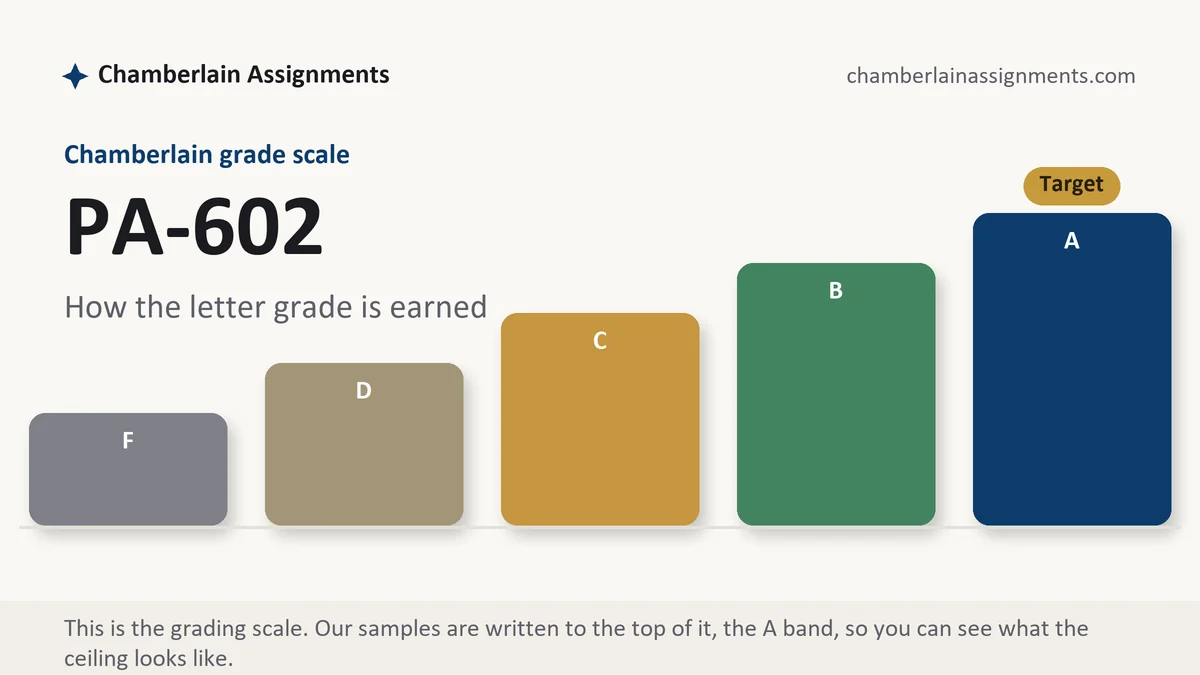
The discipline behind every paper here: the rubric is the outline, each row gets its section, one-shot discussions get the one-shot treatment, and the 76 percent floor is treated as the cliff it is. Send your week's instructions with a request and the sample matches them, revisions included.
PA-602 questions, answered
Do these samples tell me what should have been done clinically?
No, and a submission that turns into treatment advice is off the rubric anyway. The examples show the analysis the assignment asks for: the order of information, the fork where a different action was available, and the wording of what is said afterward. Clinical management belongs to your modules and your preceptors, and this seminar is not marking it.
My assignment is about a real event from my own week. Can that be used?
Send only the assignment and the rubric. A sample is written to the requirement using a constructed case matching the shape, and you fit your own event into it. That keeps the details of a real patient and a real setting out of a file that is not yours, which is also what most classrooms would prefer.
How blunt should the apology draft be?
Blunter than instinct suggests, and shorter. Rubrics in this seminar reward a statement of what happened, an acknowledgment of the effect on the person in front of you, and one concrete next thing. What they penalize is the qualifier: a sentence admitting the event and then explaining it away in the same breath scores as a defense.