Send the exact assignment or rubric from your classroom and a custom sample written to it lands in 24 to 48 hours, the first one free. NR 305 is Chamberlain’s Health Assessment for the Practicing RN course. It centers on turning everyday assessment skill into structured health histories, focused exams, and documented findings that meet academic rubrics. Searches like "NR 305 week 4 assignment example", "NR305 sample paper", and "NR 305 week samples" land on this page.
What NR 305 is really about
On the floor you assess patients constantly, so NR 305 can look like review. The catch is that the course grades documentation, not technique. Across eight weeks it revisits the complete health history, functional patterns, risk screening, and system by system assessment, and asks you to produce written records of each: interview summaries, findings tables, narrative write-ups in APA form. Many sections build toward an assessment of a real adult volunteer, which means scheduling a participant around your shifts. The gap between doing an assessment and writing one that satisfies a rubric is the whole course, and students who respect that gap early save themselves a scramble in the back half.
The weekly rhythm mirrors the rest of the RN-to-BSN track: a discussion opens the week, often a case style prompt about interpreting findings or tailoring questions to a patient population, and a written assignment tends to close it on Sunday. Assignments frequently move in stages, a health history first, then focused pieces such as family or genetic risk review, nutrition, or mental status, then a fuller head to toe narrative. Rubrics reward precise clinical language plus scholarly backing, meaning normal versus abnormal findings framed with a cited reference rather than memory. Points convert to a letter grade, and the writing volume is steadier than students expect from an assessment course.
What NR 305’s assessments ask for
Expect three kinds of asks. First, discussions that hand you a scenario, an older adult with vague complaints, a reluctant historian, a cultural consideration, and ask what you would collect and why, with sources attached. Second, structured write-ups: health history forms, risk assessments, and system focused documentation built on a template the classroom provides. Third, in many sections, a course project that assesses a volunteer participant and turns the encounter into a formal paper, sometimes with a teaching or follow up component. None of it requires new clinical skill. All of it requires translating what your hands and eyes already do into organized, cited prose, submitted on the weekly clock while you keep working.
Where students lose points in NR 305
Two transition habits drain NR 305 grades. The first is documenting from memory instead of from sources. Practicing RNs describe findings the way they would in report, quick, confident, uncited, and the rubric row asking for evidence based rationale scores it as opinion. A write-up that says why a finding matters, with a reference, outscores a sharper observation that stands alone. The second is treating discussions like a chore to clear on your day off. If your day off falls late in the week, the initial post goes up with no room left for replies, and the reply portion of the points is simply gone. A calendar fix, not a knowledge fix, but it decides letter grades here.
The NR 305 drawers
NR 305 Week 1 discussion post example
Sections typically open with an orientation discussion on what complete assessment means beyond the bedside routine. On request, free, 24-48h.
NR 305 Week 2 health history write-up example
A health history assignment often lands early, interviewing an adult and structuring the record in APA. On request, free, 24-48h.
NR 305 Week 3 focused assessment write-up example
Family and genetic risk review typically follows, turning screening questions into a written analysis. On request, free, 24-48h.
NR 305 Week 4 concept map example
Midcourse weeks often work through functional patterns, nutrition, and mental status with case style discussions. On request, free, 24-48h.
NR 305 Week 5 head to toe write-up example
In many sections the volunteer participant assessment gets scheduled and documented around this point. On request, free, 24-48h.
NR 305 Week 6 case study analysis example
System focused write-ups typically continue, pairing abnormal findings with cited rationale rather than recall. On request, free, 24-48h.
NR 305 Week 7 patient teaching plan example
The comprehensive assessment paper or presentation often comes together here from the earlier staged pieces. On request, free, 24-48h.
NR 305 Week 8 reflection example
Final week typically asks for reflection on how structured assessment will change your daily practice. On request, free, 24-48h.
Your classroom shows something else?
Chamberlain revises courses; week counts and deliverables shift between sessions. Send what your classroom shows and the desk matches it exactly.
Using a NR 305 sample the right way
A good NR 305 sample is closest to a model chart entry with citations. Study how it phrases findings, orders the history, and attaches a reference to each clinical judgment, then write your own patient's version in that frame. Do not lift language; your participant and your findings must be your own. When your section's assignment differs, and assessment projects vary widely between sections, send the exact instructions and rubric and we build a custom sample against them, first one free, usually back in 24-48h. Students often request it the week the big write-up is assigned rather than the week it is due.
How these samples are written
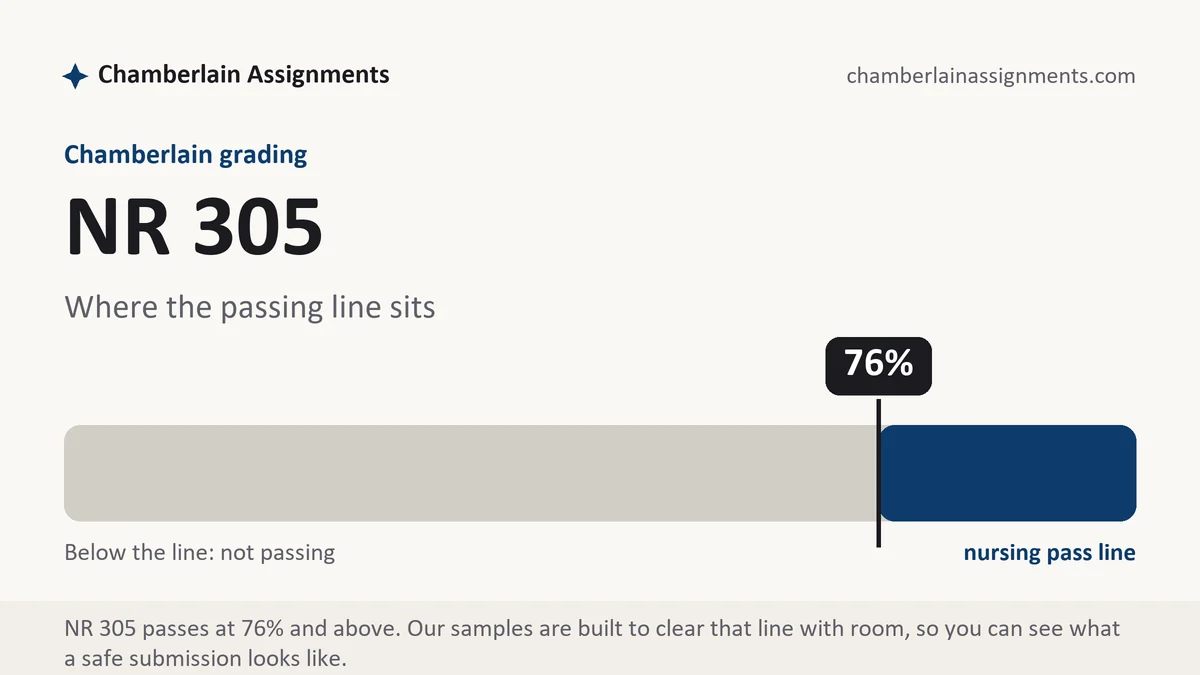
The discipline behind every paper here: the rubric is the outline, each row gets its section, one-shot discussions get the one-shot treatment, and the 76 percent floor is treated as the cliff it is. Send your week's instructions with a request and the sample matches them, revisions included.
NR 305 questions, answered
Why does my instructor keep writing 'cite your rationale' on assessment work I know is right?
Because being right is not the graded skill; showing support is. In NR 305 the rubric asks for evidence behind each judgment, so a finding explained from unit experience alone reads as uncited opinion even when it is clinically sound. Pair every interpretation with a scholarly reference. Our samples show what that pairing looks like sentence by sentence, which is faster than guessing from feedback.
What happens if I post my assessment discussion on Saturday?
In most sections the week effectively ends Sunday, so a Saturday initial post leaves classmates one day to respond and you one day to reply back. The reply exchange is where a chunk of discussion points lives, and it cannot be recovered after the week closes. Post early in the week, even briefly, and expand later. A sample post can make that early version fast.
Can you write the participant assessment paper for me?
We write samples, not submissions, and this one has to grow from your own volunteer's history and findings anyway. What we can do is build a model paper from your instructions and rubric showing structure, clinical phrasing, and citation placement, so you pour your participant's data into a proven shape. First custom sample free, typically 24-48h, sized to fit inside one assignment week.