Send the exact assignment or rubric from your classroom and a custom sample written to it lands in 24 to 48 hours, the first one free. NR 394 is Chamberlain’s Transcultural Nursing course. It centers on assessing culture's role in health decisions through established care models instead of personal impressions of patient groups. Searches like "NR 394 week 4 assignment example", "NR394 sample paper", and "NR 394 week samples" land on this page.
What NR 394 is really about
Every working RN has cared across cultures, which is precisely the trap NR 394 is built around. The course replaces accumulated impressions with formal tools: culture care theory in the Leininger tradition, structured cultural assessment models, and the vocabulary of health beliefs, communication patterns, family roles, and traditional practices. Weekly material moves between concepts and application, asking how culture shapes pain expression, end of life choices, nutrition, or care seeking, and what a nurse adjusts in response. The graded expectation is discipline: observations run through a model, supported by literature, tied to a specific care situation. It is less about knowing customs and more about demonstrating a repeatable way to learn any patient's context.
In many sections the anchor is a staged cultural project: choose a culture or population you actually encounter at work, plan an assessment, carry it through a model, and present care recommendations at the end, sometimes as a paper, sometimes as slides. Discussions run alongside on the usual Chamberlain rhythm, initial posts early in the week and replies before it closes, with written assignments gathering on Sundays. Rubrics in this course watch language closely. Words that flatten a population into a single behavior draw feedback fast, while phrasing that individualizes, many members, some families, this patient, earns the application points. That sensitivity to wording is half the grade and most of the learning.
What NR 394’s assessments ask for
The asks build on each other. Early discussions typically have you examine your own cultural lens, since the models all begin with self awareness. Midcourse work shifts to applying an assessment framework to a chosen population: beliefs about illness, healing practices, communication and space preferences, family decision structures, each grounded in published sources rather than assumption. The staged project then asks for synthesis, a care plan or teaching approach that respects what the assessment found, justified in writing. Some sections add an interview element or a workplace scenario. Across all of it the graded skill is the same motion: take a cultural observation, pass it through a model, cite the literature, and land on a nursing action a colleague could follow.
Where students lose points in NR 394
NR 394 has one dominant failure mode: the paper that generalizes where it was asked to apply. Students write that a group values family or distrusts medicine, attach a citation, and move on, and the rubric rows for model application stay unearned because no framework ever touched the page. Sweeping statements also walk papers into stereotype territory, which instructors flag hard in this course even when the sentence came from a source. The strong papers do something visibly different: they name the model, move through its domains one by one, and qualify every pattern with variation inside the group. Same knowledge, different machinery. If your draft could stand with the model's name deleted, it is not yet an NR 394 paper.
The NR 394 drawers
NR 394 Week 1 discussion post example
Sections typically start with a self assessment discussion on your own cultural lens and biases. On request, free, 24-48h.
NR 394 Week 2 cultural self-assessment example
Culture care theory and assessment models often get introduced and compared in week 2. On request, free, 24-48h.
NR 394 Week 3 cultural assessment write-up example
In many sections the cultural project opens here with a population choice and planning piece. On request, free, 24-48h.
NR 394 Week 4 transcultural case analysis example
Health beliefs, communication, and family decision patterns typically fill the midcourse discussions. On request, free, 24-48h.
NR 394 Week 5 culture care plan example
The model driven cultural assessment itself is often drafted and submitted around this week. On request, free, 24-48h.
NR 394 Week 6 cultural group analysis example
Discussions often turn to spirituality, traditional healing, and negotiating care plans respectfully. On request, free, 24-48h.
NR 394 Week 7 health promotion plan example
Care recommendations typically come together late in the session as a final paper or presentation. On request, free, 24-48h.
NR 394 Week 8 reflection example
Week 8 often asks how the model will travel back to your own unit. On request, free, 24-48h.
Your classroom shows something else?
Chamberlain revises courses; week counts and deliverables shift between sessions. Send what your classroom shows and the desk matches it exactly.
Using a NR 394 sample the right way
The most useful thing an NR 394 sample shows is the model working on the page: domain headings, patterns stated with qualifiers, sources doing the supporting, recommendations flowing from findings. Borrow that machinery for your own population and setting; the content itself will not transfer because your assessment must be yours. Sections structure the cultural project differently, so when yours diverges, send the exact instructions and rubric and we will build a custom sample around them, first one free, generally returned in 24-48h. Students often order it at the planning stage, before bad habits get drafted in.
How these samples are written
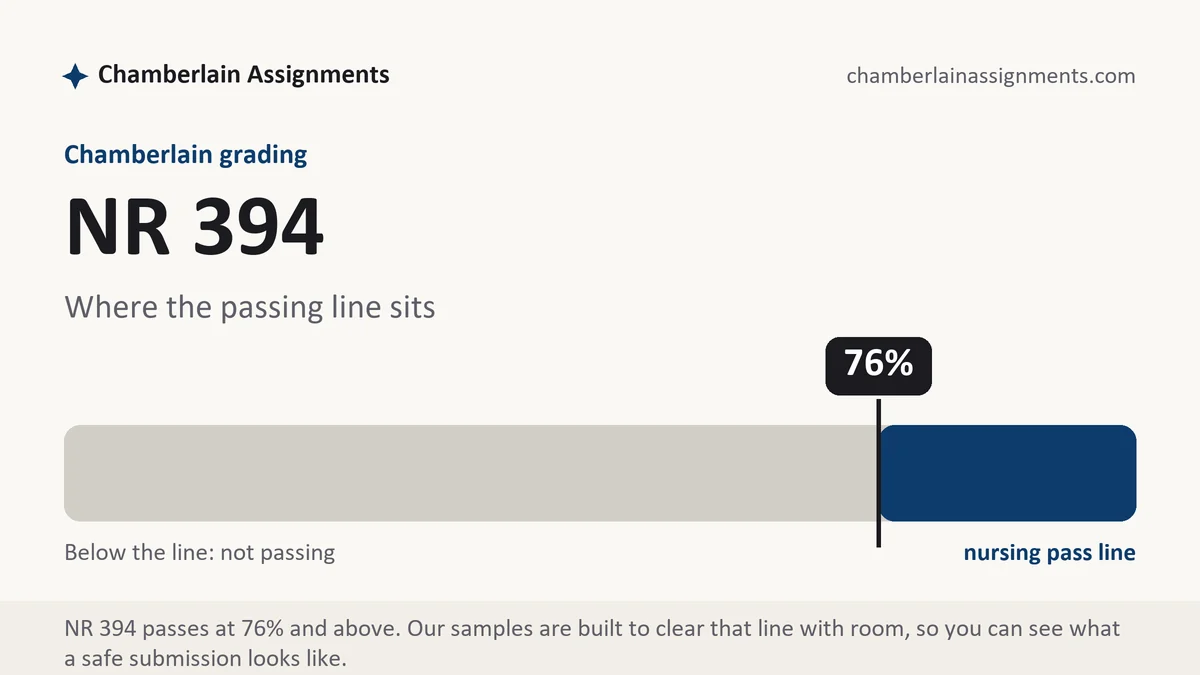
The discipline behind every paper here: the rubric is the outline, each row gets its section, one-shot discussions get the one-shot treatment, and the 76 percent floor is treated as the cliff it is. Send your week's instructions with a request and the sample matches them, revisions included.
NR 394 questions, answered
My instructor flagged my paper for stereotyping even though I cited everything. Why?
Citation does not fix a flattened claim. A sentence that assigns one behavior to an entire group reads as stereotype regardless of its source, and NR 394 rubrics grade for individualized application, not confident summary. Rework such sentences through the model's domains and add variation language: many, some, often, this patient. Our samples demonstrate that phrasing pattern across a full paper so you can hear the difference.
Which culture should I choose for the course project?
Choose one you meet at work and can research in scholarly literature, in that order. Workplace contact keeps the application sections concrete, and published coverage keeps every claim citable. Exotic or unfamiliar choices tend to push papers toward summary because there is no patient reality to anchor them. Whatever you select, the model does the analytical work; a sample built to your section's instructions can show how, free the first time, in 24-48h.
Do I really need the model if I already know the population well?
Yes, because the model is what is graded. Firsthand familiarity produces exactly the papers this course marks down: rich description, no framework, broad statements standing on experience. Rubric points sit in the application rows, so knowing the population only pays off after it is organized through the assigned model's domains with sources attached. Familiarity supplies examples; the model supplies the grade.